



Last updated: July 10, 2026
Quick Answer: Opening a pizza franchise in 2026 typically costs between $80,000 and $700,000 total, depending on the brand, location, and business model. That range covers the initial franchise fee, equipment, build-out, and working capital. Smaller counter-service or delivery-focused concepts sit at the lower end; full dine-in operations with premium build-outs push toward the top.
Real Reviews · Pinellas Park · Tampa · Houston
What Our Guests Say
Key Takeaways
- Pizza franchise cost varies widely: budget $80,000 to $150,000 for low-investment models, $200,000 to $500,000 for mid-tier concepts, and $400,000 to $700,000-plus for full-service brands
- Initial franchise fees alone typically range from $15,000 to $50,000 for most pizza concepts
- Ongoing royalty fees generally run 4% to 8% of gross sales, plus a marketing fund contribution of 1% to 4%
- Hidden costs such as grand opening fees, POS systems, uniforms, and initial inventory can add $20,000 to $50,000 beyond the published estimate
- Pizza franchises usually take 18 to 36 months to break even, depending on sales volume and local market conditions
- Low-investment pizza franchise models exist for under $100,000, including ghost kitchen and delivery-only formats
- Financing options include SBA loans, franchisor in-house financing, and equipment leasing programs
- No prior restaurant experience is required by many pizza franchisors, but business management skills matter
- Franchise costs vary by state due to real estate prices, labor laws, and permitting fees
- Comparing pizza franchise cost to opening an independent pizzeria reveals that franchises often carry higher upfront costs but lower failure risk
How Much Does It Cost to Open a Pizza Franchise?
Opening a pizza franchise costs anywhere from $80,000 to over $700,000 in total initial investment, depending on the brand and format. The most common range for a mid-tier, carry-out-focused pizza franchise falls between $150,000 and $400,000. Full dine-in concepts with larger footprints push higher.
Here is a general breakdown of what drives that total:
| Cost Category | Low Estimate | High Estimate |
|---|---|---|
| Initial franchise fee | $15,000 | $50,000 |
| Leasehold improvements / build-out | $30,000 | $300,000 |
| Equipment and smallwares | $20,000 | $150,000 |
| Initial inventory | $5,000 | $20,000 |
| Working capital (3-6 months) | $15,000 | $75,000 |
| Training, travel, and opening support | $3,000 | $20,000 |
| Miscellaneous / permits / signage | $5,000 | $30,000 |
The numbers above come directly from Franchise Disclosure Documents (FDDs), which franchisors in the United States are legally required to provide to prospective franchisees before any money changes hands.

What’s Included in Pizza Franchise Startup Fees?
The startup fee, often called the initial franchise fee, is a one-time payment that grants you the right to operate under the brand. For most pizza franchises, this fee covers brand licensing, initial training, access to proprietary recipes and systems, and pre-opening support.
What the initial fee typically covers:
- Brand license: The right to use the franchisor’s name, logo, and trademarks
- Training program: Usually 1 to 4 weeks of classroom and in-store instruction
- Operations manual: Proprietary systems, recipes, and procedures
- Site selection assistance: Help evaluating locations and lease terms
- Grand opening support: On-site team assistance for the first days of operation
What it does NOT cover: real estate, construction, equipment, inventory, or working capital. Those are separate line items that can dwarf the franchise fee itself.
Common mistake: Many first-time buyers focus on the franchise fee and underestimate build-out costs. A $25,000 franchise fee can come attached to a $200,000 build-out requirement. Always read the full Item 7 of the FDD, which lists the complete estimated initial investment.
What Are Ongoing Royalty Fees for Pizza Franchises?
Pizza franchises charge ongoing royalty fees that typically range from 4% to 8% of gross weekly or monthly sales. On top of that, most brands require a marketing fund contribution of 1% to 4% of gross sales.
So if your location generates $600,000 in annual sales, you might pay:
- Royalty (6%): $36,000 per year
- Marketing fund (2%): $12,000 per year
- Total ongoing fees: $48,000 per year
These fees are non-negotiable in most franchise agreements and continue for the life of the contract, typically 10 years with renewal options. Some brands also charge technology fees, POS licensing fees, or local advertising requirements on top of the national fund.
Choose this model if: You value brand support, national marketing campaigns, and proven supply chain relationships enough to justify the ongoing cost. If you’d rather keep 100% of revenue, an independent pizzeria may suit you better, but the tradeoffs are significant.
What Are the Hidden Pizza Franchise Costs People Don’t Expect?
Beyond the published investment range, several costs catch new franchisees off guard. These hidden expenses can add $20,000 to $60,000 to your actual out-of-pocket cost.
The most common surprises include:
- Grand opening marketing fee: Many franchisors require a separate local marketing spend of $5,000 to $15,000 at launch
- POS and technology setup: Point-of-sale systems, online ordering integrations, and third-party delivery platform onboarding can run $5,000 to $15,000
- Uniforms and branded merchandise: Required branded apparel and packaging often costs $2,000 to $8,000 upfront
- Security deposits: Commercial leases typically require first and last month’s rent plus a security deposit
- Pre-opening payroll: You’ll be training staff for 2 to 4 weeks before the doors open, which means paying wages before you earn a dollar
- Insurance: Commercial general liability, workers’ compensation, and property insurance can cost $8,000 to $20,000 annually
- Architect and permit fees: Health department approvals, fire suppression systems, and ADA compliance can add $10,000 to $30,000 in older or complex spaces
The safest approach is to add 15% to 20% to whatever total investment estimate the franchisor provides.
Cheapest Pizza Franchise to Open: Best Pizza Franchises for Low Investment
The cheapest pizza franchise options start around $50,000 to $100,000 total investment, primarily through delivery-only, ghost kitchen, or counter-service models. These formats eliminate dining room build-out costs, which are the single largest expense driver.
Low-investment pizza franchise formats worth evaluating:
- Ghost kitchen / delivery-only: No storefront required; operates from a shared commercial kitchen. Total investment can fall under $75,000 in some markets.
- Counter-service carry-out: Small footprint (600 to 1,200 sq ft), minimal seating, lower build-out cost. Total investment often ranges from $80,000 to $175,000.
- Kiosk and food hall concepts: Emerging format with lower rent and build-out, though limited in menu scope.
For investors seeking a proven concept with multiple revenue streams at a competitive entry point, exploring current pizza franchise opportunities is a smart first step. Some newer concepts specifically designed for efficiency and high volume offer strong unit economics without requiring a massive footprint.
If you’re researching the best new pizza franchise options for 2026, look for brands that offer both carry-out and delivery models with ghost kitchen compatibility, as those formats carry the lowest barrier to entry.
Edge case: The cheapest option is not always the best option. A $60,000 ghost kitchen franchise with weak brand recognition may generate far less revenue than a $200,000 concept with strong local demand and a loyal customer base.
Pizza Franchise Cost vs. Opening an Independent Pizzeria
A pizza franchise typically costs more upfront than opening an independent pizzeria, but franchises carry significantly lower failure risk and come with built-in brand recognition, supply chains, and operational systems.

Here is how the two models compare:
| Factor | Pizza Franchise | Independent Pizzeria |
|---|---|---|
| Startup cost range | $80,000, $700,000 | $75,000, $400,000 |
| Brand recognition at opening | High (established brand) | Zero (build from scratch) |
| Ongoing royalties | 4%, 8% of gross sales | None |
| Menu flexibility | Limited (brand standards) | Complete freedom |
| Training and support | Structured, ongoing | Self-directed |
| Estimated 5-year survival rate | Higher (franchise system support) | Lower (industry average) |
For someone with no restaurant background, a franchise provides a structured path that an independent startup simply cannot replicate. For an experienced restaurateur with a unique concept and local following, the royalty burden of a franchise may not make sense.
How Long Does It Take to Break Even on a Pizza Franchise?
Most pizza franchise owners reach break-even between 18 and 36 months after opening, assuming average sales performance for their brand and market. High-volume locations in strong markets can break even in 12 to 18 months; underperforming locations in saturated markets may take longer.
Break-even timing depends on:
- Average Unit Volume (AUV): The higher your weekly sales, the faster you recover your investment
- Total investment amount: A $150,000 investment breaks even faster than a $500,000 one at the same sales level
- Rent as a percentage of sales: Ideally, rent should not exceed 8% to 10% of gross sales
- Labor efficiency: Well-managed labor costs (target 25% to 30% of sales) accelerate profitability
- Local competition: A market with strong demand and limited competition shortens the timeline
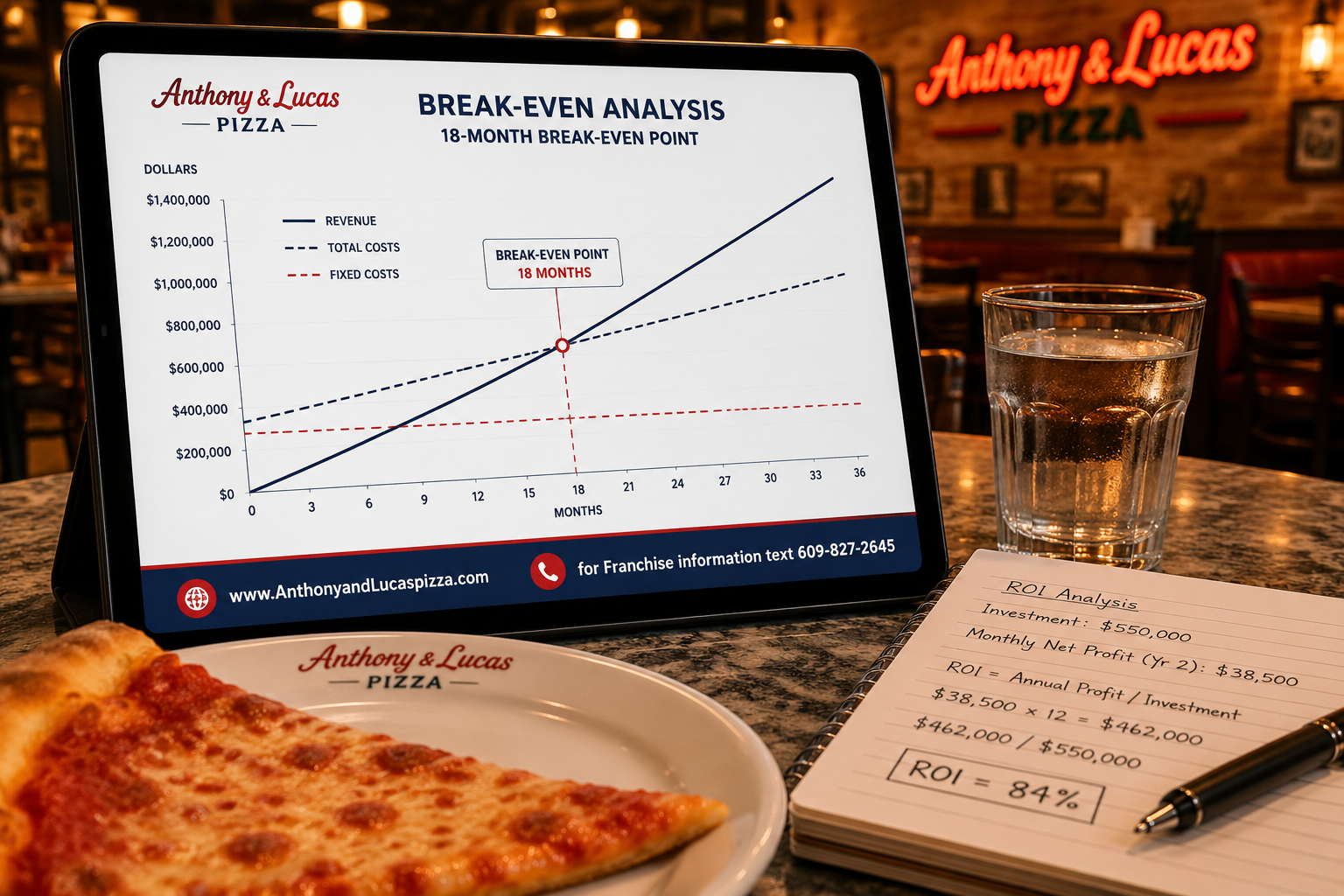
Quick example: A franchisee invests $250,000 total and generates $650,000 in annual sales with a 12% net profit margin. Annual net profit: $78,000. Simple payback period: roughly 3.2 years. That does not account for the time value of money, but it gives a useful baseline.
What’s the Difference Between Pizza Franchise Brands by Price?
Pizza franchise brands fall into three broad investment tiers, and the price difference reflects real differences in brand strength, support infrastructure, and revenue potential.
Budget tier ($50,000 to $150,000 total investment): Typically smaller or emerging brands, delivery-focused models, or ghost kitchen concepts. Lower brand recognition but faster entry and lower risk exposure.
Mid-tier ($150,000 to $400,000 total investment): Established regional or national brands with proven systems, moderate AUVs, and carry-out or fast-casual formats. This is where most serious franchise investors operate.
Premium tier ($400,000 to $700,000-plus total investment): Full-service or high-volume concepts with strong brand equity, dine-in capability, and multiple revenue streams. Higher risk, but also higher ceiling for revenue.
Concepts like Anthony & Lucas’s New York Pizza Franchise combine authentic New York-style pizza with Philadelphia cheesesteaks and Italian street food, creating a multi-revenue-stream model that competes in the mid-to-premium tier with strong unit economics. The menu breadth, including hand-stretched dough made from Brooklyn-sourced water, Grande brand cheese, premium imported tomatoes, and authentic Cooper Sharp cheesesteaks, differentiates the concept from commodity pizza brands.
For a deeper look at current options, the pizza franchise 2026 overview covers the landscape across investment tiers.
Do Pizza Franchises Require Commercial Kitchen Space?
Yes, virtually all pizza franchises require a dedicated commercial kitchen that meets local health department standards. The kitchen must include commercial-grade ovens, ventilation (hood and exhaust systems), fire suppression, and food prep surfaces that comply with NSF and local code requirements.
Requirements typically include:
- Type I or Type II hood system depending on cooking equipment
- Three-compartment sink for dishwashing
- Handwashing sink separate from prep areas
- Walk-in cooler or reach-in refrigeration meeting food safety temperatures
- Grease trap connected to municipal sewer in most jurisdictions
- Health department permit and periodic inspections
Ghost kitchen and shared kitchen models reduce the capital burden by renting certified commercial space by the hour or month, which is why they carry lower startup costs. A pizza kitchen franchise that includes a full stone-deck oven setup will have higher equipment and build-out costs than a delivery-only concept using a conveyor oven in shared space.
Edge case: Some municipalities require a separate commissary agreement even for ghost kitchen operators, which adds a recurring cost. Always verify local regulations before signing a lease.
Can You Open a Pizza Franchise With No Experience?
Most pizza franchisors do not require prior restaurant experience, but they do expect business management capability, adequate capital, and a willingness to follow the system. The franchise model is specifically designed to transfer operational knowledge to people who have never run a restaurant.
That said, no experience is not the same as no preparation. Franchisors typically require:
- Completion of their training program (1 to 4 weeks, often at a corporate location)
- Demonstrated net worth and liquid capital minimums
- Background check and business reference review
- Commitment to owner-operator involvement, especially in the first year
The most successful first-time franchisees tend to have backgrounds in retail management, sales, or operations, even if not in food service specifically. The skills that matter most are team management, customer service orientation, and financial discipline.
If you have no food service experience but strong business instincts, exploring a pizza franchise opportunity with robust training infrastructure is the right move. Brands that offer multi-week hands-on training at an operating location give you the best foundation.
Pizza Franchise Financing Options and Loans
Most pizza franchise investors do not pay the full investment out of pocket. Common financing options include SBA loans, franchisor financing programs, equipment leasing, and ROBS (Rollover for Business Startups) using retirement funds.
SBA 7(a) loans are the most widely used tool for franchise financing. The Small Business Administration guarantees a portion of the loan, which reduces lender risk and allows borrowers to access up to $5 million with competitive interest rates and longer repayment terms (up to 10 years for working capital, up to 25 years for real estate). According to the SBA, franchise businesses have historically shown strong loan performance compared to independent startups.
Other financing paths:
- Franchisor in-house financing: Some brands offer deferred franchise fees or direct lending to qualified candidates
- Equipment leasing: Leasing ovens, refrigeration, and POS systems reduces upfront capital requirements, though it increases monthly operating costs
- ROBS: Using 401(k) or IRA funds to invest in a franchise without early withdrawal penalties. This is legal but complex and requires a specialized attorney or financial advisor
- Conventional bank loans: Require strong personal credit (typically 680+), collateral, and 2 to 3 years of business or management history
- Friends and family investment: Common for first-time buyers but requires clear legal agreements to protect relationships
Decision rule: If you have $80,000 to $100,000 in liquid capital, an SBA loan can often bridge the gap to a $200,000 to $300,000 total investment. If you have less than $50,000 liquid, most mid-tier franchisors will not approve your application.
Which Pizza Franchises Are Most Profitable?
The most profitable pizza franchises combine high average unit volumes (AUV) with lean operating costs, multiple revenue channels, and strong brand loyalty. Profitability varies by location and operator, but brands with AUVs above $700,000 annually and net margins of 10% to 18% represent the top performers.
Key factors that drive pizza franchise profitability:
- Menu breadth: Concepts that sell pizza, sandwiches, and Italian street food generate higher per-ticket averages than pizza-only menus
- Multiple service channels: Dine-in, carry-out, delivery, catering, and online ordering together produce more consistent revenue than single-channel models
- Ingredient quality and differentiation: Premium ingredients justify higher menu prices and drive repeat visits
- Operational efficiency: Small footprint, streamlined prep, and cross-trained staff reduce labor costs
Anthony & Lucas’s approach, combining authentic New York-style pizza with genuine Philadelphia cheesesteaks and Italian street food items, is a strong example of this multi-revenue model. The Anthony & Lucas pizza franchise is built around authentic ingredients including Brooklyn-sourced dough, Grande cheese, imported tomatoes, and Cooper Sharp cheesesteaks on authentic Philadelphia rolls, which support premium pricing and strong customer loyalty.
For investors weighing options, the hottest pizza franchise concepts in 2026 share one common trait: they offer more than just pizza.
Pizza Franchise Cost in Different States and Regions
Pizza franchise cost varies meaningfully by state and region, primarily driven by real estate prices, construction labor costs, minimum wage laws, and local permitting complexity. The same franchise concept can cost $100,000 to $200,000 more to open in California or New York than in the Southeast or Midwest.
Key regional cost drivers:
- Real estate and rent: Commercial rents in major metros (New York, Los Angeles, Chicago) can be 3 to 5 times higher than secondary markets in Florida, Texas, or the Midwest
- Construction and build-out labor: Union labor markets in the Northeast and West Coast significantly increase build-out costs
- Minimum wage: States with $15 to $20 minimum wages increase ongoing labor costs, which affects break-even timelines
- Permitting and licensing: Some cities require extensive health department pre-approvals, fire marshal inspections, and zoning variances that add time and cost
- Sales tax on food: Varies by state and affects pricing strategy
Practical example: Opening a mid-tier pizza franchise in Tampa, Florida might cost $180,000 total. The same franchise in Manhattan could cost $450,000 or more due to higher rent, union build-out labor, and city permitting fees.
For buyers in the Southeast, concepts with established regional presence offer a cost advantage. Reviewing pizza franchise for sale listings in your target market gives you real numbers to compare against the FDD estimates.

FAQ
What is the average total pizza franchise cost in 2026? The average total investment for a pizza franchise in 2026 falls between $150,000 and $400,000 for most mid-tier, carry-out-focused concepts. Full dine-in or premium brands can reach $500,000 to $700,000 or more.
What is the typical initial franchise fee for a pizza brand? Most pizza franchise initial fees range from $15,000 to $50,000. This one-time payment covers brand licensing, training, and pre-opening support but does not include real estate, equipment, or build-out.
How much are pizza franchise royalty fees? Royalty fees for pizza franchises typically run 4% to 8% of gross sales per month, plus a marketing fund contribution of 1% to 4%. On $600,000 in annual sales, combined fees often total $36,000 to $72,000 per year.
What is the cheapest pizza franchise to open? Delivery-only and ghost kitchen pizza franchise models can be opened for as little as $50,000 to $100,000 total. These formats eliminate dining room build-out costs and reduce equipment requirements.
Can I finance a pizza franchise with an SBA loan? Yes. SBA 7(a) loans are widely used for pizza franchise financing. Most lenders require a credit score of 680 or higher, some collateral, and a down payment of 10% to 30% of the total project cost.
Do I need restaurant experience to open a pizza franchise? Most pizza franchisors do not require prior restaurant experience. They do require adequate capital, business management skills, and completion of their training program, which typically runs 1 to 4 weeks.
How long does it take to break even on a pizza franchise? Most pizza franchise owners break even within 18 to 36 months. High-volume locations in strong markets can reach break-even in 12 to 18 months.
What hidden costs should I budget for beyond the FDD estimate? Budget an additional 15% to 20% above the franchisor’s stated investment range to cover grand opening marketing, POS setup, pre-opening payroll, insurance deposits, and permit fees.
Does pizza franchise cost vary by state? Yes, significantly. Real estate, construction labor, minimum wage laws, and permitting complexity can make the same franchise concept cost $100,000 to $200,000 more in high-cost states like California or New York compared to lower-cost markets in the Southeast or Midwest.
What makes a pizza franchise more profitable than others? Menu breadth, multiple service channels (dine-in, delivery, catering), premium ingredient differentiation, and lean operations are the strongest predictors of profitability. Brands with AUVs above $700,000 and net margins of 10% to 18% represent top performers.
Is a pizza franchise a better investment than an independent pizzeria? For most first-time food service investors, yes. Franchises carry higher upfront costs but offer brand recognition, proven systems, and lower failure risk. Independent pizzerias offer more flexibility and no royalties but require you to build everything from scratch.
What is a Franchise Disclosure Document (FDD) and why does it matter? The FDD is a legally required document that franchisors must provide before any investment is made. Item 7 lists the full estimated initial investment; Item 19 discloses financial performance data. Reading both carefully is essential before committing any capital.
Conclusion
Understanding pizza franchise cost before you invest is not just smart, it is essential. The published franchise fee is rarely the full story. Build-out, equipment, working capital, ongoing royalties, and the hidden costs most buyers miss can easily double the number you see in a brand’s marketing materials.
The clearest path forward starts with these steps:
- Request and read the full FDD for any brand you’re seriously considering, paying close attention to Item 7 (total investment) and Item 19 (financial performance)
- Talk to existing franchisees listed in Item 20 of the FDD to get honest feedback on actual costs and revenues
- Get pre-qualified for SBA financing before you approach franchisors, so you know your real budget
- Compare at least three brands across different investment tiers before committing
- Hire a franchise attorney to review the franchise agreement, not just a general business attorney
If you’re drawn to a concept that combines authentic New York-style pizza, genuine Philadelphia cheesesteaks, and Italian street food, the multi-revenue-stream model is worth serious evaluation. Brands built on premium ingredients and operational simplicity tend to outperform single-product concepts over time.
The right pizza franchise investment is one where the numbers work in your specific market, the brand has genuine differentiation, and the support infrastructure matches what you need as an operator. Start with the data, verify everything in the FDD, and make your decision from a position of knowledge rather than enthusiasm.